
Opening of the Estonian Business Centre in Riga 26.05.2025
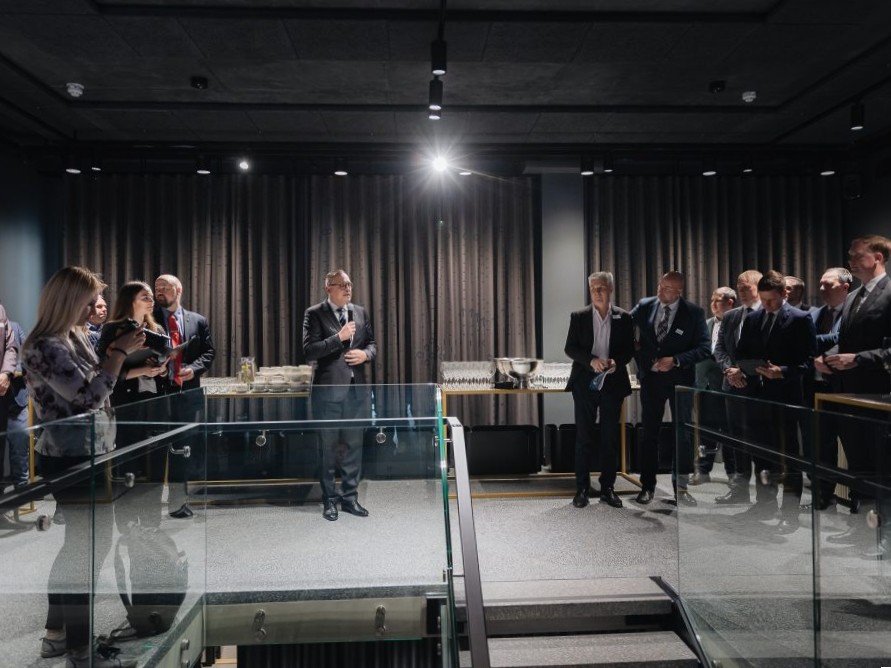
On 26 May 2025, the Estonian Business Centre was opened in Riga, on Cēsu Street. It is an Estonian investment of more than 13 million euros. A new building, conceived as a permanent meeting place for entrepreneurs from both countries. The opening was attended by Estonia’s Minister of Economic Affairs and Industry, Erkki Keldo, and Latvia’s Minister of Economics, Viktors Valainis. The Livonia awards were also presented to entrepreneurs. We were there too, the Latvian Textile Industry Association.
But honestly, sitting in that new building in the centre of Riga, we were thinking not about Tallinn. We were thinking about Daugavpils. And about why an opportunity may now be opening up for Latgale that has not been seen in years.
A neighbour who is ahead of us
For years Estonia has been the Baltic neighbour that is doing better. Wages confirm it. At the end of 2025 the average wage in Estonia exceeded 2150 euros a month. In Latvia it was around 1815 euros. The gap is not huge, but it is steady, and in manufacturing every euro per hour of work counts.
Around 150 companies work in Estonia’s apparel sector. They mostly produce for the Finnish and Swedish markets, where customers pay for quality and reliability. That is a good position. But, as wages rise at home, even a good position raises a simple question. Where to produce, so as to stay in Europe, close to the customer, with quality work, but without Scandinavian costs?
The big wave called nearshoring
This is not just an Estonian question. The whole European fashion industry has been moving production closer to home in recent years. In English it is called nearshoring. In Latvian, simply, bringing production closer.
The reasons are practical. The pandemic showed how fragile a supply chain becomes when it stretches 10 thousand kilometres across oceans. An order that used to take six weeks suddenly took sixteen. While some were waiting for containers from Asia, others who produced in Europe were already restocking shelves.
The numbers now speak for themselves. Producing in Asia means a design must be approved four to six months before it reaches the store. Producing in Europe needs six to ten weeks. On top of that come the European Union’s new requirements for sustainability and transparency in the supply chain. About seven out of ten fashion companies plan to bring production closer to Europe. This wave has already begun, and it is looking for places to land.
Latgale’s other side
In Latgale, the average wage is the lowest in Latvia, around 1300 euros. The gap with Riga is nearly 34 percent. People usually talk about this as a problem, and it is one.
But there is another side. In Latgale there is a skilled workforce that needs work. There are people who know how to work with fabric, machine and hand. And there is something that cannot be built in a day and cannot be bought at any price. A textile tradition.
Three hundred years of needle and thread
Textile is nothing new in Latgale. The first textile manufactory here started work as early as 1724. That is more than three hundred years of continuous experience.
In Soviet times Daugavpils was a serious industrial centre. The Chemical Fibre Factory, founded in 1964, worked here. So did the garment factory “Daugavpils apģērbs”, which sewed coats and suits. Thousands of people knew the rhythm of a factory and what well-done work means.
Then much of it stopped. Markets disappeared, factories closed, the work left. But skill does not disappear in one generation. It stays in the hands, in memory and in the attitude towards work. In Latgale, it is still there.
But people leave
And here is a truth that cannot be hidden. The population in Latgale is shrinking faster than in any other region of Latvia. From internal migration alone, with people moving to Riga or elsewhere, Latgale lost almost 18 thousand inhabitants between 2000 and 2019. Demographers forecast that the region may lose another percent of its population each year.
The reason is often simple. Young people finish school, leave to study and do not return. Not because they do not love their home region. But because there is no work to stay for.
This is why we were sitting in the Estonian Business Centre thinking about Daugavpils. Because everything lined up. Europe is looking for places to produce closer. Estonians find it expensive at home. And in Latgale there is skill, tradition and people who need work.
An idea that came up in the conversations
This is exactly what we discussed with our Estonian partners. Part of the textile production could be moved to Latgale. Not because it is cheap. But because there is tradition, skill and people who want to work.
It is important that we say this distinction out loud. We do not want to sell Latgale as cheap labour. That would be demeaning and short-term. There will always be somewhere cheaper, and people stay just as poor. We want to show Latgale as a place where good textile work has been at home for three hundred years and where it is valued.
What it would actually take
We are not naive. For this idea to become real, one conversation and good intentions are not enough. Investment in equipment is needed. Training of new workers is needed, because part of the experience has gone with the old factories. Reliable partners on both sides of the border are needed, and clear rules.
This is work for years, not months. But that is exactly why an association exists. To bring together those who produce, those who look for a producer, and those who can help with financing and training. For a single company, such a task is too large. Together it is doable.
If you are part of this story
This is only the beginning of a conversation, and we do not hide it. But big things often start exactly like this. With one conversation in a new building in the centre of Riga, where someone finally asks: why not Latgale?
If your company produces in Latgale or is considering it, we want to talk with you. If you are an Estonian or other foreign partner looking for a production site in Europe with a deep textile tradition, write to us. We know the region and we know the people, and we will help you find the right contacts. And if you simply care about work coming back to Latgale, become a member. The more of us, the louder we are heard.